
COM203 Assignment 1 : AI Workflow Optimisation Task
Business Overview
My new venture StartSmart Finance Advisory will share small business owner’s information on their business performance and allow the business owner to make well-versed business decisions. It’s the answer to the concern that many entrepreneurs undergo, which is that they’re unable to appreciate the economic details even with accounting data. There will be monthly health checks on economics with the help of monetary budgeting, assessment, financial planning as well as simple reporting via online sessions.
AI Workflow Optimisation
StartSmart Finance Advisory is an organization that helps small business owners with easily understandable details about the financial performance of their businesses. Four of the more mundane things a typical solo consultancy can do on the day, that can be optimized by AI, were highlighted as follows: Client Onboarding, Monthly Financial Reports, Scheduling Meetings, Filling Sending Follow-up Reports; and Answering Emails and Responses from Clients.
The four tasks selected represented tasks that were commonly encountered by all clients, constituted a mix of predictable data sharing and written communication requests, and directly influenced the time needed to complete high value analysis and advisory activities. They cover the whole customer lifecycle of a relationship with a client from initial contact to ongoing advice.
As AI becomes part of each workflow, it is anticipated that the time dedicated to the first draft will be significantly cut down. Time to manually prepare a month of financial information for a client to review and adjust is typically 30-45 minutes per client; ChatGPT can prepare a summary based on structured inputs and then review and adjust, the time of which is approximately 10-15 minutes per client. If it’s used for a pipeline of on-going clients, it can save the advisor a couple of hours a week that can be spent rolling up advisory time on the client account, where the real billable value and time is.
Ethical issues were integrated into each workflow and not an add-on. StartSmart Finance Advisory manage data which is very sensitive . AI’s decisions and role are kept bounded with respect to interpreting data in terms of structure or description (this is where AI comes in), and evaluative judgments (which precede the consultant and remain with him/her) when making decisions and judgements on a client’s decisions and financial position.
Assignment 1 Tasks
Task 1: AI-Assisted Client Onboarding & Financial Intake
Purpose: In order to effectively understand the client’s financial background as well as identify the key focus areas, along with making a transition in the engagement process without wasting any consultant’s time in manually reading and summarizing the raw intake answers.
Tools used: Google Forms, ChatGPT
Workflow Diagram
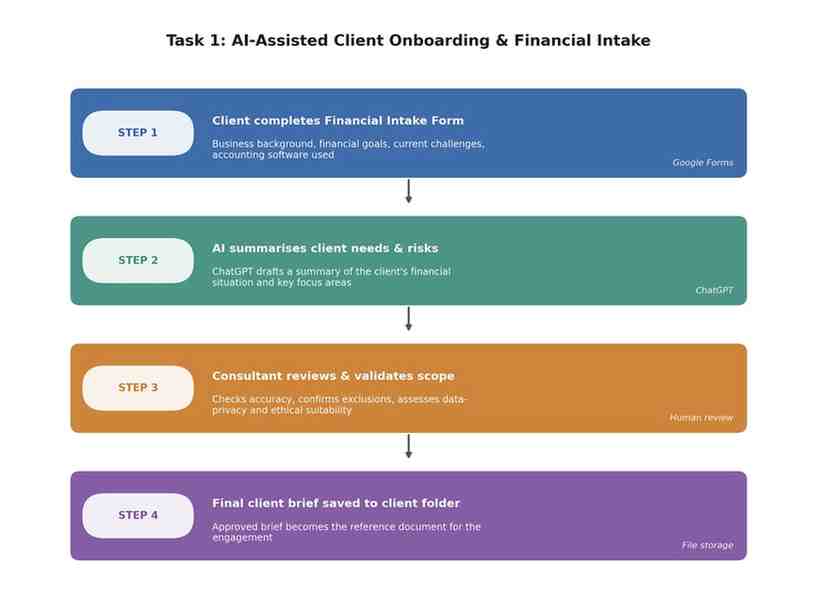
Step 1: Client finishes Financial Intake Form
Consumption form structure from the client to collect companies background information, objectives, time frame, financial constraints/ sensitivities, etc.
Step 2: AI summarises client needs and risks
The ChatGPT form answers are fed into the ChatGPT through a structured prompt. The ChatGPT makes a summary of main factors of the consumer’s needs, key anxieties, risk areas as well as ethics.
Step 3: Consultant reviews & refines scope
The consultant then reads through planned scope and scope exclusions, and determines whether the proposed scope is accurate and if the proposed scope is ethical based on AI generated immediate and then modifies somewhat inaccuracies or assumptions.
Step 4: Final brief saved to client folder
Once it has been revised as well as revised, the customer brief is finalised and kept in the appropriate client folder for reference during the engagement.
Mock Demonstration
This is a sample of the AI system used in this workflow: The prompt used and the draft generated by the AI system prior to human review by the consultant.
Task 2: AI-Assisted Monthly Financial Health Report Drafting
Purpose: AI provides a preliminary financial status report of a client, allows the consultant to review it and tweak things to finalize a monthly financial health report and not have to write a narrative from scratch.
Tools used: Accounting software (Xero/QuickBooks), ChatGPT
Workflow Diagram
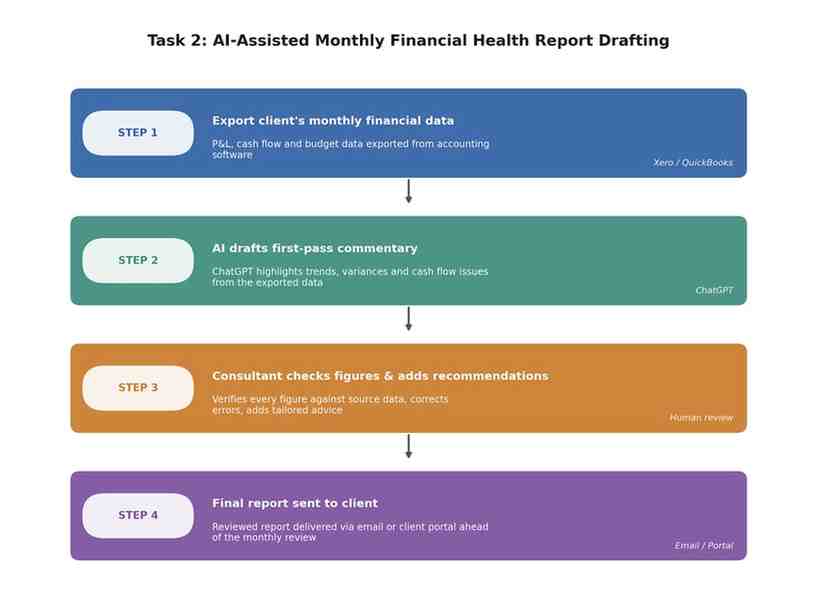
Step 1: Export monthly financial data
AI can input the relevant figures regarding the profit and loss, cash flow, and budget figures directly into the accounting software of the client, without the necessity for manual input of these figures.
Step 2: AI drafts first-pass commentary
This exported statistic is then processed by ChatGPT and a specific prompt is given which that AI then uses to produce a first draft for a plain-English commentary looking for trends, outlier data and potential cash flow issues.
Step 3: Consultant checks figures and adds recommendations
The consultant verifies each number in the draft and corrects any misread or misinterpreted numbers, and adds to the draft professional, client-specific recommendations that AI would not be able to responsibly add.
Step 4: Final report sent to client
The presented and finalised report is sent via email to the Client or via the portal, and is ready for use for the monthly discussion on the financial health.
Mock Demonstration
The mockup below is a sample of the process which can be performed using the AI tool—where a prompt is entered into the tool and a draft output is produced before being check by a consultant.
Task 3: AI-Assisted Meeting Scheduling & Follow-Up Summaries
Purpose: the consultant will be able to save time and effort in scheduling the appointment and in summarizing the meeting in a first draft that gets automatically generated; the finalised document will be under his control and won’t be automatically created, thus providing him with a valuable instrument to use when drafting the final copy.
Tools used: Calendly, Otter.ai, ChatGPT
Workflow Diagram
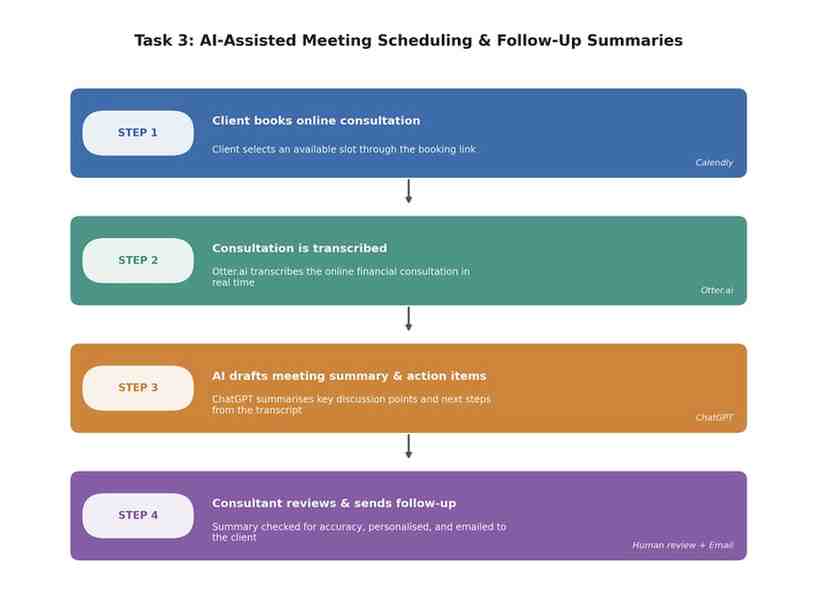
Step 1: Client books online consultation
A scheduling link is supplied for the client for him/her to schedule a consultation without having to pass around and request his schedule.
Step 2: Consultation is transcribed
Otter.ai transcribes the conversation during the consultation, allowing the advisor to emphasis on the dialogue, instead of taking notes.
Step 3: AI drafts meeting summary/action items
Transcript is then passed to ChatGPT, which is asked to summarize the key discussion points as well as agreed action items, as well as to generate a draft of this, for review.
Step 4: Consultant reviews & sends follow-up
The consultant reads the meeting summary generated by the AI to compare with their memory of the meeting and then corrects, adjusts tone and sends the follow-up to the client.
Mock Demonstration
Below is a mock-up of this workflow without the use of the AI tool, a prompt is given and a draft output is generated, prior to being reviewed by the consultant.
Task 4: AI-Assisted Client Email & Query Response Drafting
Purpose: Saves time in drafting routine responses to common client questions; all answers are accurate in regard to finances, and are customized for the specific client before being sent to the consumer.
Tools used: Gmail, ChatGPT
Workflow Diagram
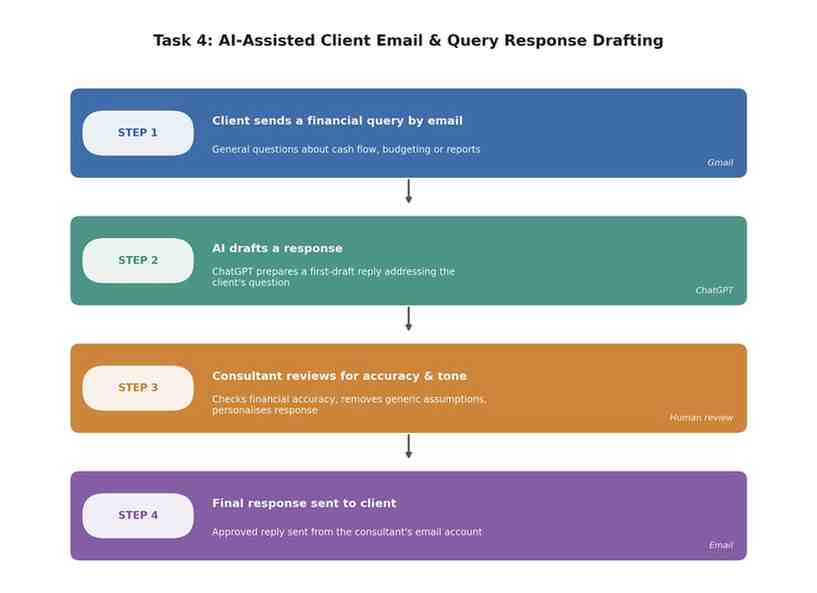
Step 1: Client sends a financial query
The client sends a general enquiry, e.g., why they have a profit figure which is not reflected in their bank account.
Step 2: AI drafts a response
A first draft, easy-to-understand response is generated from ChatGPT that is limited to general financial concepts and not the client’s confidential financial information to answer the client’s question.
Step 3: Consultant reviews for accuracy and tone
The consultant analyzes the draft as well as marks out any general or incorrect suppositions and modifies it into the constituent’s specific draft based on the numbers and scenario of the consumer.
Step 4: Final response sent to client
Any answers that are given to clients are correct and verified and only sent after the client has approved and personalised the answers.
Mock Demonstration
The following mock-up shows the use of the AI tool in this process: the input of a prompt and the draft generated created before it is reviewed by the consultant.
Need Help with COM203 Consulting and Freelancing Assignment 1?
Native Singapore Writers Team
- 100% Plagiarism-Free Essay
- Highest Satisfaction Rate
- Free Revision
- On-Time Delivery