
EAS201: In the field of aerospace propulsion, define the terms propulsive efficiency: Aerospace Propulsion Assignment, SUSS, Singapore

Updated: 29 Oct 2026 Free Assignment Question
Table of Contents

    Need a Custom-Written Answer for This Question?

    Our Singapore-based academic experts write 100% original, Turnitin + Originality.ai checked answers — delivered within your deadline.

    Request Plagiarism-Free Answer

    🔒 100% confidential · No data stored

    Get a 100% Human-Written Answer (AI-Free) Free quote in 10 minutes · 100% confidential
      University Singapore University of Social Science (SUSS)
      Subject EAS201: Aerospace Propulsion

      Question 1 

      (a) In the field of aerospace propulsion, define the terms propulsive efficiency ηP, thermal efficiency ηT and overall engine efficiency ηO.

      (b)
      (i) From the definition of overall engine efficiency ηO, develop an expression for it in terms of aircraft velocity V0 and the TSFC. Show the steps clearly and
      provide a glossary of terms used.

      (ii) Using this expression, explain the effect of increasing aircraft speed on the
      engine overall efficiency, assuming the engine is ideal.

      (c) For an ideal turbojet engine, analyze how the overall engine efficiency and TSFC would change with compressor pressure ratio. Illustrate with relevant thermodynamic equation(s) and a graphical sketch.

      Question 2

      Consider an ideal turbojet engine operating under the following conditions:
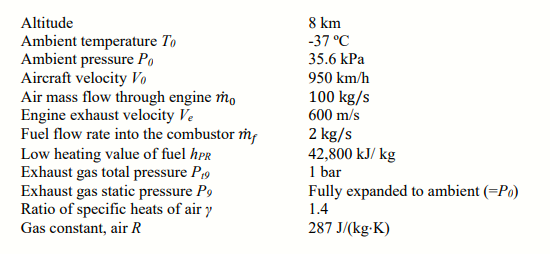
      EAS201: In the field of aerospace propulsion, define the terms propulsive efficiency: Aerospace Propulsion Assignment, SUSS

      Taking into consideration the effects of fuel mass flow on engine thrust, evaluate the following:

      (a) Net thrust.

      (b) Specific thrust.

      (c) Power output of the engine.

      (d) Engine thermal efficiency.

      (e) Propulsive efficiency and overall engine efficiency

      (f) Thrust-specific fuel consumption.

      (g) Exhaust exit Mach number.

      (h) Gas static temperature at exhaust exit.

      (i) Exhaust nozzle exit area.

      (j) From the above answers, deduce the cross-sectional profile of the core engine exhaust duct. Explain the rationale for your answer. Further calculations are not needed.


      Buy Custom Answer of This Assessment & Raise Your Grades

      Get Help By Expert

      Singapore Assignment Help is the best place for getting SUSS Assignment Help for EAS201: Aerospace Propulsion Assignment at a low cost. Our brilliant writers provide proper assistance to achieve a higher rank in your aeronautical engineering assignment as per the professor's deadline.

      Do you need a fresh written answer for this question?

      100% human-written, Turnitin + Originality.ai checked — delivered before your deadline.

      Request Answer →

      Shared with

      Singapore Assignment Help Editorial Team – Aerospace Propulsion desk
      Singapore Assignment Help Editorial Team – Aerospace Propulsion desk

      A student shared this brief with our team; personal details have been removed. Our Aerospace Propulsion desk works on tasks like this and can guide you on how to approach it.

      It's your first order?

      Use discount code SAH15 and get 15% off

      Need this question answered?