
| University | Nanyang Technological University (NTU) |
| Subject | Power Electronics Systems |
Objectives:
- To undertake a mini-research and write a brief on the operation principle of a single-phase half-controlled bridge rectifier converter.
- Using the provided circuit parameters to simulate and evaluate the performance of the single-phase half-controlled bridge rectifier in MATLAB/SIMULINK
- To undertake a mini-research and write a brief on the operation principle of a DC/DC buck converter.
- Using the provided circuit parameters to simulate and evaluate the performance of the buck converter in MATLAB/SIMULINK
- Shows the circuit diagram of a single-phase half-controlled bridge rectifier with an RL load. As shown, it consists of thyristors (T1 and T2), the diodes (D1 and D2), and a freewheeling diode, FW.
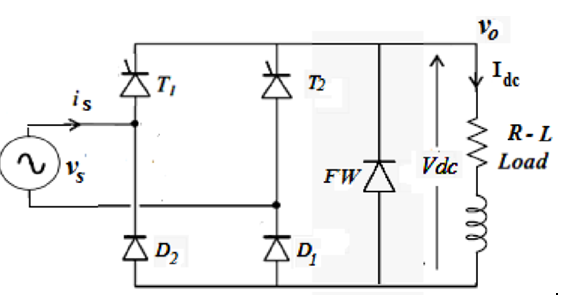
- By citing relevant literature, and using relevant waveform diagrams, explain the working principle of the circuit including the role of the freewheeling diode
- By referencing relevant waveform diagrams, derive the expression for the average load voltage,, the RMS load voltage, the average current, and the RMS load current, of the circuit for a purely resistive load [when L=0]
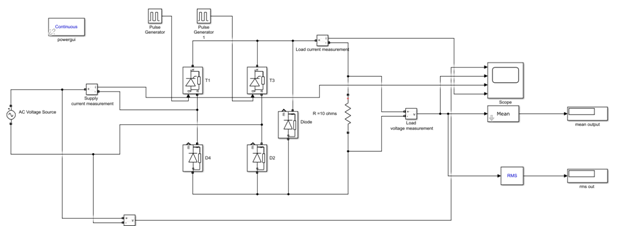
- Build the circuit in SIMULINK and simulate the operation of the rectifier with a purely resistive load, the supply voltage of, supply frequency of 50Hz, and the thyristor firing angle set to(). Present the graphs of your simulation results. Comment on the output voltage and current waveform profiles. Can it be used to power a DC circuit (like a DC motor) in its current form? Explain
- Compare the measured average and the RMS output voltage with the calculated values obtained using the expressions derived in (a)(ii) above. Discuss your findings?
- Now update the load by connecting an inductor in series with the load. Simulate the circuit operation with and present your output voltage and current waveforms and the average and RMS output voltage values. Compare the obtained values with the measured values obtained in (b) (ii) above. Discuss your findings.
- Repeat b(iii) above with and present the output voltage and current waveforms. Also, present the average and the RMS values of the output voltage and current. Explain the effects of the change of firing angle to the average output voltage and current profiles and magnitudes.
- Increase the load inductance to and repeat step (b)(iii) above and present the average output voltage and current waveforms. Compare the results with the ones obtained in (b) (iii) above. Explain the effects of change of inductance in the load to the average load current profile.
Hire a Professional Essay & Assignment Writer for completing your Academic Assessments
Native Singapore Writers Team
- 100% Plagiarism-Free Essay
- Highest Satisfaction Rate
- Free Revision
- On-Time Delivery
Get Help By Expert
If you looking for a report writer then, look no further visit our website singaporeassignmenthelp.com. and hire a Ph.D. expert writer who can provide you a report writing service in which you get your Power Electronics Systems Report in a flawless & 100% plagiarism-free manner at a cheap price.
Answer

Looking for Plagiarism free Answers for your college/ university Assignments.
Recent Solved Questions
- COR1100 Writing and Reasoning Assessment 3 , 2026 | SMU
- LOG206 Transport Management and Technology Group-based Assignment 2026 | SUSS
- NCO212 The ‘Smart City’ and Society Pre-Class Quiz Assignment 2026 | SUSS
- CVEN3501 Water Resources Engineering Coursework Brief 2026 | UNSW
- MKTG101 Marketing Coursework Brief 2026 | Singapore Management University
- NCO102 Effective Writing Tutor-Marked Assignment 1, 2026 | SUSS
- SC1101E Making Sense of Society Written Assignment 1 Brief 2026 | NUS
- BUSM2653 People Analytics Assesment 1 Insightful Analytics Report 2026 | SIM
- MLA604 Maritime Operations Assessment Brief 2026 | MLA College
- ICT226 Enterprise Systems and Integrated Business Process End-of-Course Assessment 2026 | SUSS